ServiceNow alternative for small IT teams: Why Jira + AMFJ wins
Choosing an IT Service Management (ITSM) platform is a decision that defines how your team works for years. For large enterprises with 20,000 employees and a small army of certified administrators, ServiceNow is the standard. But what if you're a lean IT team in a mid-sized company?

Colin Reed
IT Expert and Content Writer
Last Updated

Finding a ServiceNow alternative for small IT teams is a critical step for organizations that have outgrown spreadsheets but aren't ready for the complexity of enterprise software.
Most lean teams need speed and agility, not a multi-year implementation project that drains resources. It's often about finding a Jira asset management solution that keeps things simple while providing enterprise-grade depth.
If you've spent any time researching a ServiceNow alternative for small IT teams, you've likely felt the weight of the "Enterprise Tax." ServiceNow is powerful, but it's often a mismatch for the agility small teams need. The complexity that provides "protection" for a global bank becomes pure friction for a fast-moving IT department.
There is a pragmatic path forward. By combining Jira Service Management (JSM) with Asset Management for Jira (AMFJ), you get 80% of ServiceNow's power at a fraction of the cost and complexity. It's about choosing speed to value over a multi-year implementation roadmap. Let's break down why this combination is the smart move for your team.
The ServiceNow "bloat" problem for small teams
ServiceNow is built for the Fortune 500. Its architecture assumes you have dedicated "platform owners" whose only job is to maintain the tool. For a small IT team, this isn't just a cost issue; it's an operational burden.
We've seen it repeatedly. A team buys ServiceNow because it's the "market leader," only to realize they need to hire an outside consultant just to change a simple form or workflow. This "Enterprise Tax" extends beyond the initial license fee. You're paying for certified ServiceNow administrators and expensive implementation cycles that can span 9 to 18 months for enterprise organizations [Source: https://lovable.dev/guides/jira-vs-servicenow-itsm-comparison].
For an agile team, this is the opposite of what you need. You need a service desk that you can configure in an afternoon, not a platform that requires a six-month "discovery phase." Small teams often find themselves "trapped" in a tool that is too heavy to move and too expensive to ignore. This leads to the "spreadsheet chaos" where assets are tracked in Excel because the main tool is just too difficult to update.
The frustration is real. You want to resolve incidents and deploy hardware, not manage the software that's supposed to help you do those things. When the tool becomes the work, it's time to look for a leaner ServiceNow alternative for small IT teams.
Jira Service Management vs ServiceNow: At a glance
To understand why so many teams are switching, we need to look at the metrics that actually matter to a manager. It's not just about feature checklists; it's about how quickly you can see a return on your investment.
Metric | Jira Service Management (JSM) | ServiceNow ITSM |
|---|---|---|
Implementation Speed | ||
3-Year TCO (200 agents) | ||
Configuration | ||
Pricing Model | ||
Primary Audience | Agile / DevOps / Mid-market | Large Enterprise (10k+ employees) |
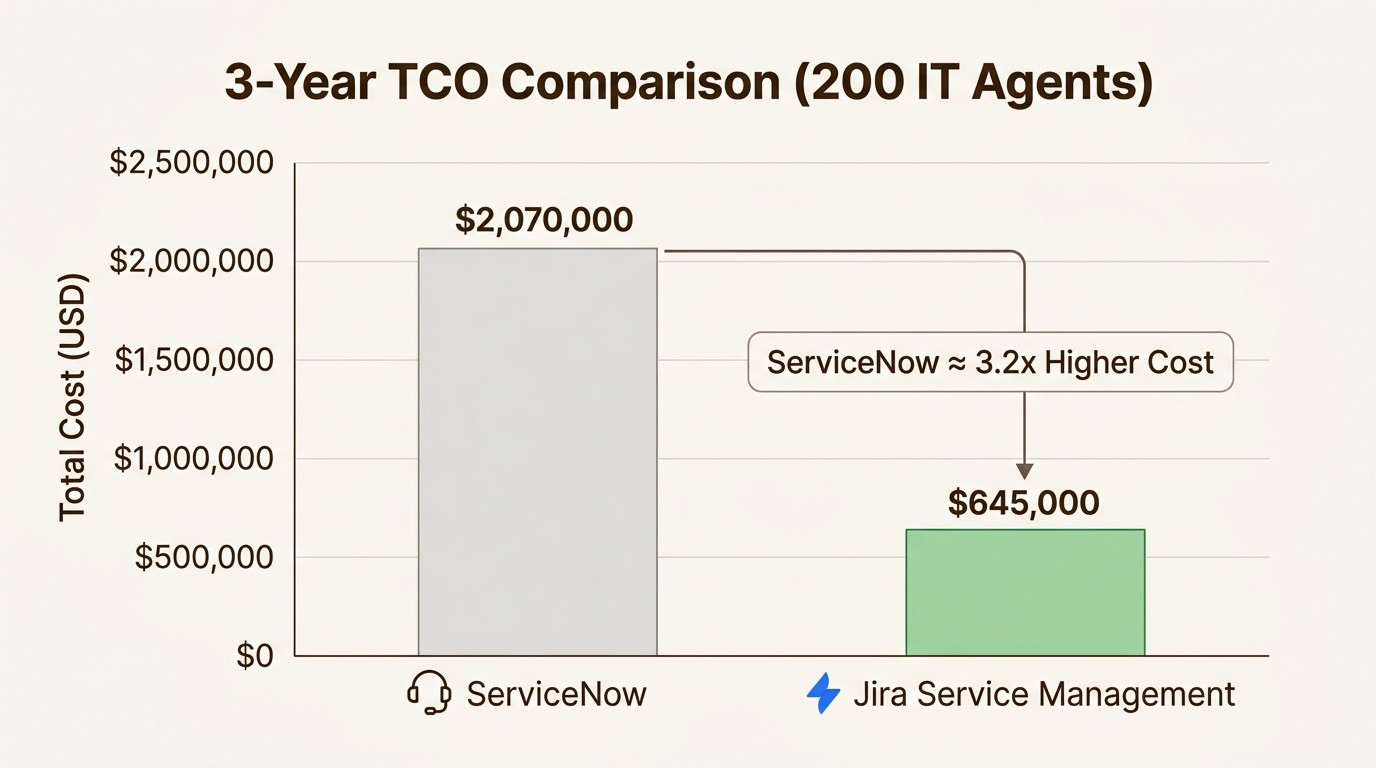
The numbers tell a clear story. ServiceNow is roughly 3.2x more expensive than JSM over a three-year period. But for a small team, the time gap is even more critical. Getting up and running in two months vs. nearly two years is the difference between a successful rollout and a project that loses momentum before it ever goes live.
JSM uses a template-driven approach. If you need a standard ITIL-aligned service desk, you can launch it with pre-configured workflows. ServiceNow, by contrast, often starts as a blank slate that requires extensive coding and customization to match your specific processes.
Why Jira Service Management is the smart ServiceNow alternative
If your organization is already using Jira Software for development, the decision to use Jira Service Management as your ServiceNow alternative for small IT teams is almost a no-brainer. This "DevOps-First" philosophy ensures that your IT and Development teams work in the exact same environment.
When a support ticket turns into a bug report, there isn't any "integration" required. You simply link the JSM ticket to a Jira Software issue. Both teams see the same data, the same comments, and the same status updates. This eliminates the "us vs. them" wall that often exists between support and engineering.
Pricing is another area where JSM wins on pragmatism. Unlike ServiceNow's opaque "custom quotes," JSM offers transparent pricing. To learn more about the costs of asset tracking specifically, you can check our guide on asset tracking cost.
Plan | Price (Monthly) | Key Inclusions |
|---|---|---|
Free | $0 (up to 3 agents) | Basic ticketing, 2GB storage |
Standard | $20 / agent | 250GB storage, 5,000 Asset objects |
Premium | $51.42 / agent | Unlimited storage, 99.9% SLA, 50,000 Asset objects |
Enterprise | Custom (Annual) | Unlimited sites, 500,000 Asset objects |
For a 10-person IT team, you can have a professional-grade service desk for as little as $200 per month. This low barrier to entry allows you to start small, prove the value, and scale as your company grows. You're not forced into a massive contract before you've even resolved your first ticket.
Solving the asset management gap with AMFJ
While Jira Service Management is excellent for ticketing, asset management is often where small teams hit a wall. JSM does have a native "Assets" feature (formerly Insight), but it's only included in the Premium and Enterprise tiers. For a small team, jumping to the Premium tier just to track 500 laptops can feel like another "Enterprise Tax."
This is where we built Asset Management for Jira (AMFJ) to be the missing piece of the puzzle. We designed AMFJ specifically to be the complete ServiceNow alternative for small IT teams who need powerful asset tracking without the Premium price tag or complexity.
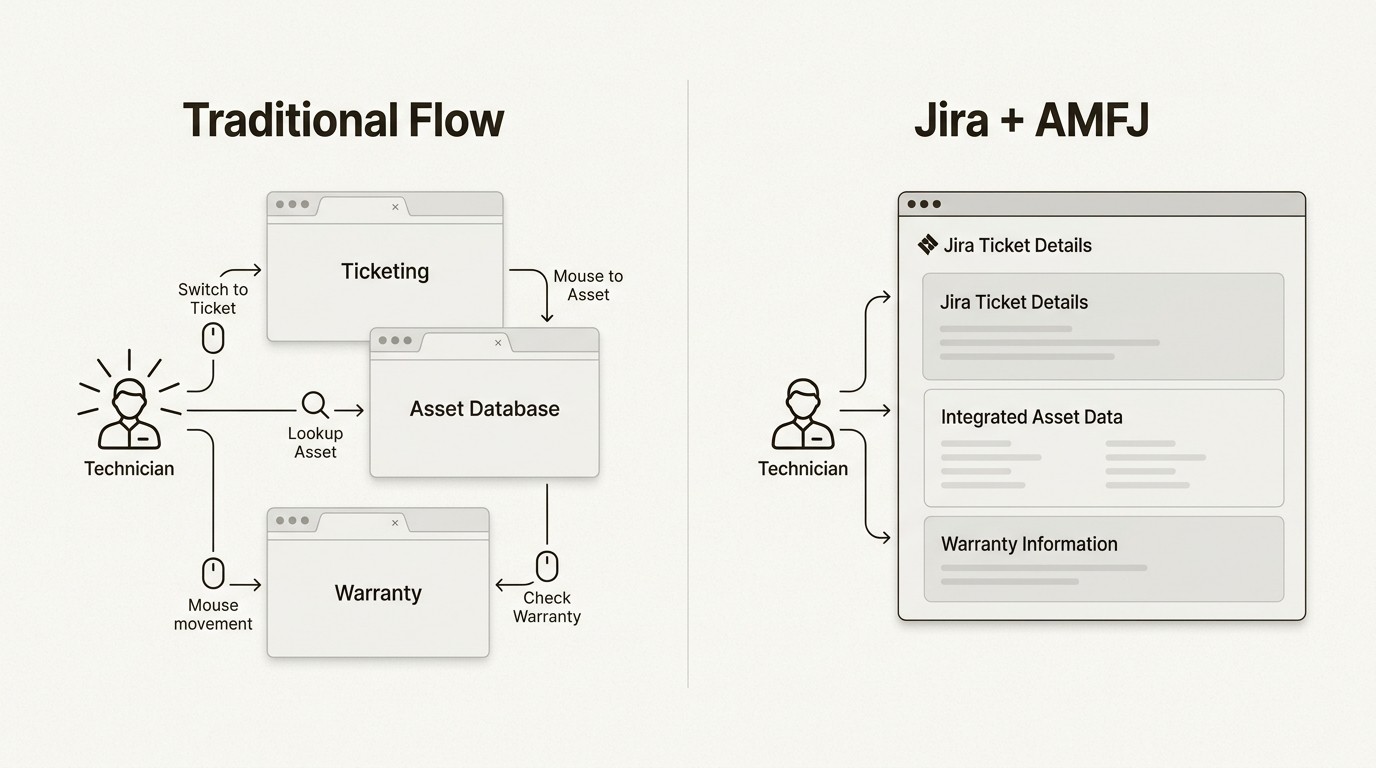
Our approach is different. AMFJ is truly native, meaning it lives directly inside your Jira UI. It's not a separate database that you have to "sync" or "link" via a plugin. When a technician opens a Jira ticket, they see the user's full device history right there in the sidebar.

Automation is at the core of what we do. We know small teams don't have time for manual data entry. That's why we offer automated MDM sync with the tools you already use:
Microsoft Intune: Automatically sync hardware specs and user assignments.
Jamf Pro: Keep your Apple fleet data current without lifting a finger.
Kandji: Streamline your Apple device management directly in Jira.
Beyond hardware, managing your subscriptions is just as critical, and we provide tools for software license management as well.
Unlike enterprise tools that charge "per object" (meaning you pay more every time you add a monitor or a keyboard), our pricing is tiered per-user and includes unlimited assets.
Users | Price (Monthly) | Features |
|---|---|---|
1-10 Users | $10 (Flat rate) | Unlimited assets, MDM sync, QR codes |
11+ Users | From $2.85/user | All features, volume discounts |
This predictability is vital for a growing IT department. You know exactly what your bill will be, regardless of how many peripherals or licenses you need to track.
3 reasons small IT teams choose Jira + AMFJ over ServiceNow
When you zoom out from the feature lists, the choice of a ServiceNow alternative for small IT teams comes down to three practical advantages.
1. Zero context switching
Productivity dies in the "tab dance." If your technicians have to jump between a ServiceNow tab for assets and a Jira tab for development bugs, they're losing focus and time. With our features, the asset data is part of the ticket. You can see when a laptop was purchased, its warranty status, and its previous repair history without ever leaving the screen where you're typing the resolution.
2. Speed to value
In a small team, you don't have six months to wait for a tool to be "ready." You need to solve problems today. Because JSM uses low-code templates and AMFJ can import your existing spreadsheets in minutes, you can have a complete ITSM and ITAM solution running before a ServiceNow consultant even finishes their initial "discovery phase." This rapid implementation allows you to show ROI to your leadership almost immediately. It also simplifies the process for offboarding employee equipment recovery when people leave the company.
3. No specialized overhead
One of the biggest hidden costs of ServiceNow is the "Admin Tax." You essentially need to hire a developer just to manage your support tool. With Jira and AMFJ, your existing IT team can manage the system. If you need a custom field or change a workflow, you do it yourself in the settings panel. There's no need for a specialized platform owner or an expensive external contract just to keep the lights on.
Choosing the right ITSM path for your team
ServiceNow is a remarkable platform, but it's built for a scale that most small and mid-sized teams simply don't need. It's like buying a semi-truck to deliver a pizza; it's powerful, but it's slow to turn and expensive to fuel.
The combination of Jira and AMFJ is built for the agile IT team. It's about being "simply powerful." We believe that you should spend your time improving your company's technology, not fighting with the tools meant to track it.
By choosing this path, you're not just saving 3.2x on costs; you're gaining the ability to resolve tickets faster and manage your inventory with 95% accuracy. You can explore our features and see how we help teams eliminate spreadsheet chaos in days, not months. For detailed insights into your fleet, you can also set up asset management reporting that gives you a clear view of your technology investments.
Ready to see why Jira + AMFJ is the best ServiceNow alternative for small IT teams? We offer a 30-day free trial with no credit card required. It's time to stop paying the Enterprise Tax and start working at high velocity.
Start your free trial of Asset Management for Jira
Frequently Asked Questions
Why is Jira Service Management considered a better ServiceNow alternative for small IT teams?
Jira Service Management offers a faster implementation cycle (60-90 days vs. 18 months for ServiceNow) and a lower total cost of ownership. Its low-code interface and native integration with Jira Software provide agility without the need for specialized administrators.
How does the cost of a ServiceNow alternative for small IT teams like JSM compare to ServiceNow?
Industry analysis shows ServiceNow is roughly 3.2x to 5x more expensive than Jira Service Management. A 3-year TCO for 200 agents can reach $2.07M for ServiceNow compared to $645,000 for JSM.
Can Jira handle asset management as well as ServiceNow?
Yes, especially when paired with a dedicated solution like Asset Management for Jira (AMFJ). AMFJ provides a native experience inside Jira with unlimited assets and automated MDM sync, offering the depth of enterprise tools with far less complexity.
Do I need a certified administrator to manage a ServiceNow alternative for small IT teams?
No. Jira and AMFJ are designed for ease of use, allowing existing IT teams to configure workflows and track assets themselves without hiring specialized consultants or platform owners.
Does this ServiceNow alternative for small IT teams integrate with Microsoft Intune?
Yes. Asset Management for Jira (AMFJ) offers automated sync with Microsoft Intune, Jamf Pro, and Kandji to keep your device inventory accurate without manual data entry.