Top 5 GLPI alternatives to consider in 2026
Searching for a GLPI alternative in 2026? I compared the top 5 tools for IT asset management, from open-source to enterprise, to find the best fit.

Colin Reed
IT Expert and Content Writer
Last Updated

GLPI is a classic open-source tool for IT asset and service management. Its flexibility is a known advantage, but this can also require significant technical expertise for setup, maintenance, and navigating its interface.
If you find that managing your asset tool takes more time than managing your assets, it may be time to explore other options. I reviewed several GLPI alternatives to compare them on key factors for modern IT teams: ease of use, integration capabilities, and transparent pricing.
What is a GLPI alternative?
A GLPI alternative is any tool that handles IT Asset Management (ITAM), and sometimes broader IT Service Management (ITSM) functions. While GLPI provides an all-in-one open-source solution, its competitors often take a different approach.
They might be cloud-based platforms that eliminate the need for self-hosting, or tools that integrate directly into systems you already use, like Jira. Some are enterprise-level solutions built for large organizations. The goal is always the same, tracking your hardware, software, and licenses, but the experience, cost, and features can be completely different.
How I chose the best GLPI alternative tools
To create a useful list, I focused on key attributes that address common reasons teams move away from GLPI. This is about how a tool fits into your daily work.
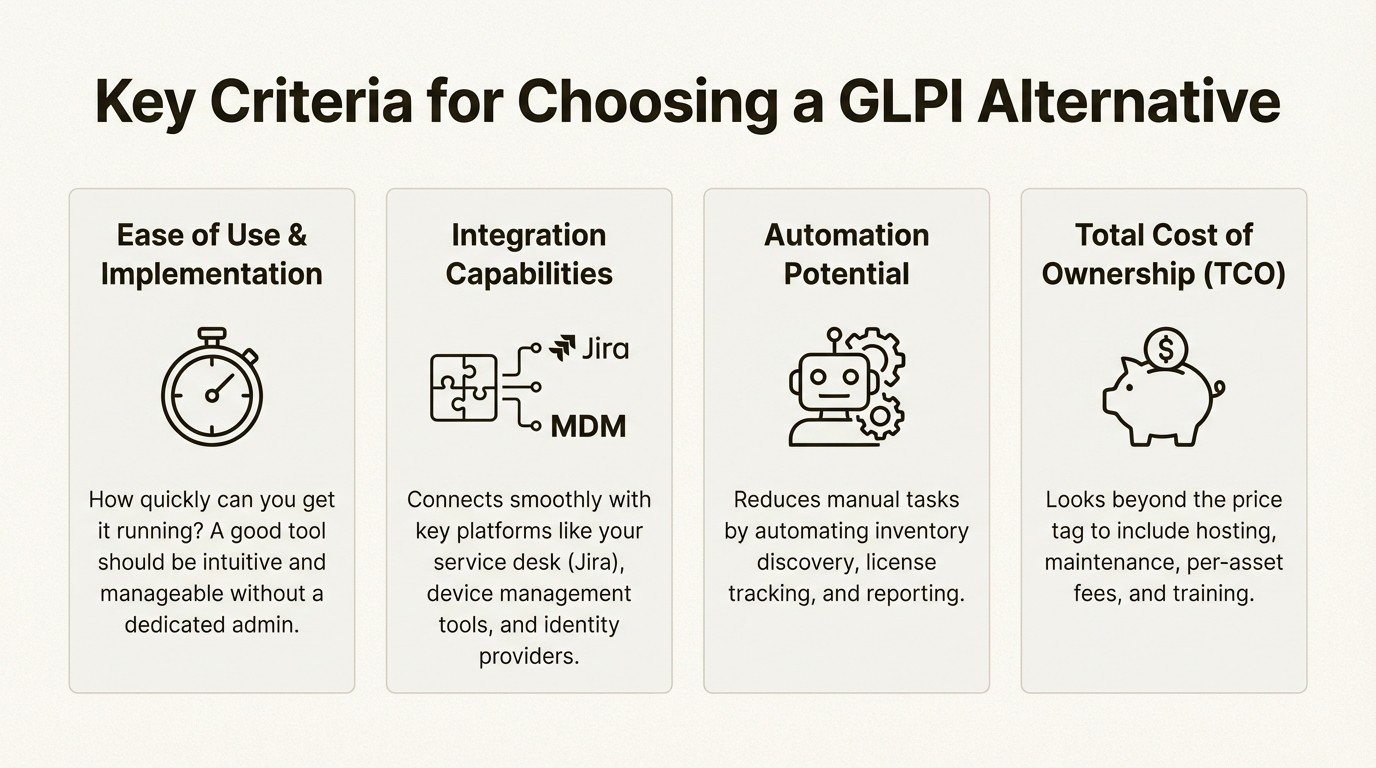
Ease of use and implementation: How quickly can you get it running, and is it intuitive for your team? A good tool should be manageable without requiring a dedicated administrator.
Integration capabilities: Modern IT does not operate in a vacuum. I looked for tools that connect smoothly with key platforms like your service desk (especially Jira), device management tools (MDM), and identity providers.
Automation potential: A significant part of ITAM is reducing manual tasks. The best options automate functions like inventory discovery, license tracking, and reporting.
Total cost of ownership (TCO): I looked beyond the price tag to consider other costs like hosting, maintenance, per-asset fees, and training. The total cost of ownership considers factors beyond the initial price tag.
A quick comparison of the top GLPI alternatives
Tool | Best For | Key Strength | Pricing Model | Free Tier Available |
|---|---|---|---|---|
Asset Management for Jira | Teams already using Jira | Native Jira workflow integration | Tiered, per-user | 30-day trial |
Snipe-IT | Teams wanting an open-source solution | Self-hosting and customization | Free (self-hosted) / Paid hosting | Yes (self-hosted) |
ServiceNow ITAM | Large enterprises | Enterprise workflow automation | Custom enterprise quotes | No |
Jira Service Management (Assets) | Teams needing a full CMDB in Atlassian | Deep ecosystem integration | Per-agent bundle + consumption fees | No (feature not in Free plan) |
Freshservice | Mid-sized teams needing integrated ITSM/ITAM | User-friendly interface | Per-agent, tiered | 14-day trial |
The top 5 GLPI alternatives in 2026
Here’s a more detailed look at the tools that made my list, with all the latest info.
1. Asset Management for Jira: A native Jira GLPI alternative
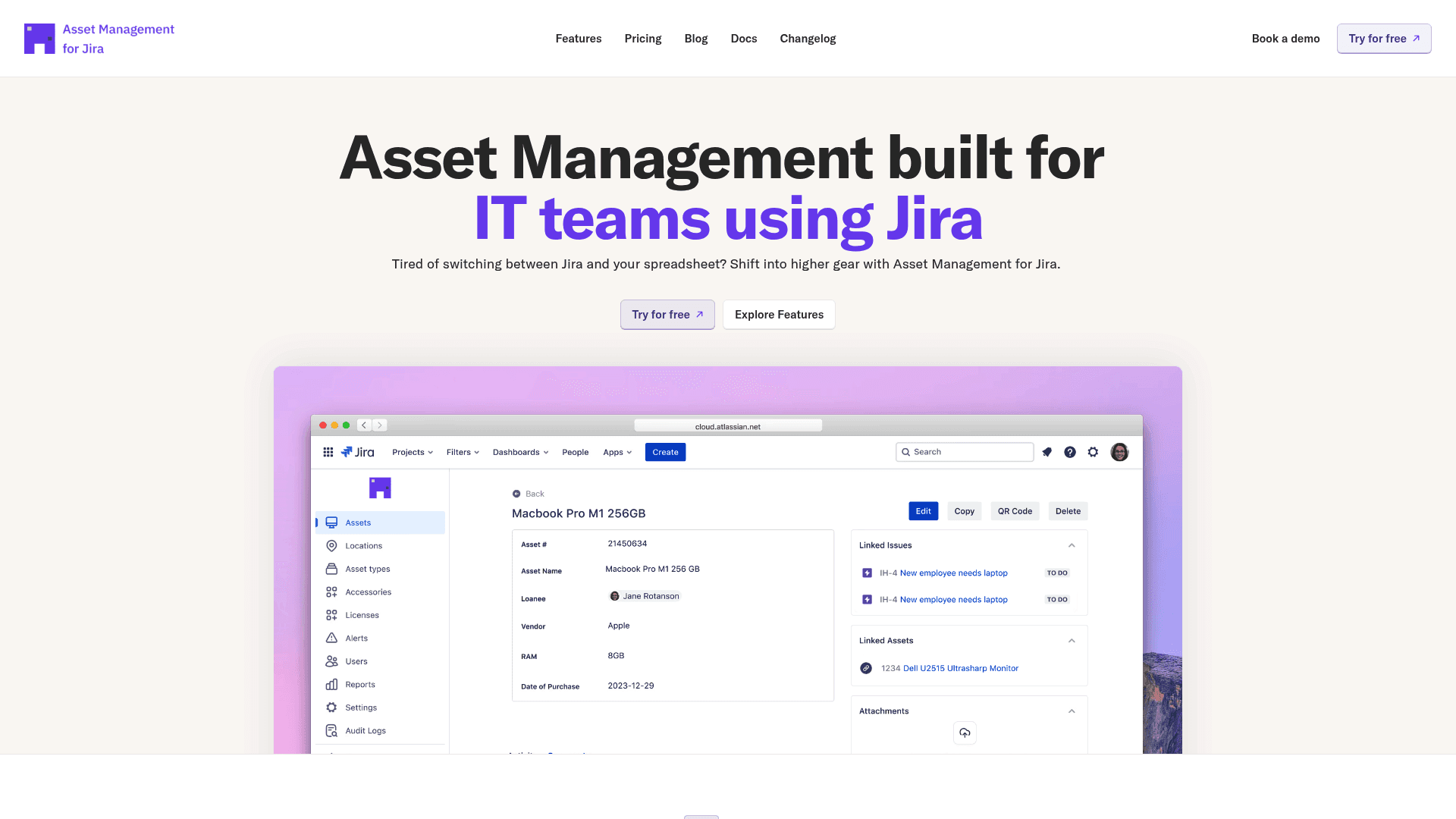
Asset Management for Jira is designed for a common situation: an IT team works in Jira and finds it inefficient to use spreadsheets or a separate tool for asset tracking. It operates within Jira, which significantly impacts workflow efficiency. When a support ticket comes in, all the necessary asset info, like a laptop's serial number, purchase date, and related tickets, is readily available.
Its main strength is its native integration with Jira. It adds custom fields and asset data that can be used in Jira Automation, queues, and reports. It also syncs with MDM tools like Intune, Jamf Pro, and Kandji, which keeps your inventory updated automatically.
This focus is also its primary limitation, as it requires Jira to function. It's a dedicated ITAM tool, not a comprehensive ITSM platform like ServiceNow, so it is not designed to manage an entire service delivery framework. But for teams that are all-in on Jira, it’s a focused and accessible option.
Pricing
The pricing is predictable, based on your number of Jira users, and it includes unlimited asset tracking. This contrasts with models that charge per asset.
Up to 10 users: $10/month (Standard) or $20/month (Advanced).
11+ users: Pricing is tiered, starting at $2.85 per user/month.
For the thousands of teams using Jira Service Management, this is a logical choice. It solves the core problem of asset tracking without creating another system to manage, and its quick setup means you can get value from it in hours, not weeks.
2. Snipe-IT: An open-source GLPI alternative

For anyone looking for a direct open-source replacement for GLPI, Snipe-IT is a frequent consideration. Like GLPI, it’s free if you host it yourself, which gives you total control over your data. It handles all the ITAM basics well: asset tracking, license management, accessories, and consumables.
You can check assets in and out to users, view a history of who's had what, and get email alerts for expiring warranties and licenses. The community around Snipe-IT is active and the documentation is good, which is helpful for an open-source project.
The primary advantage is the cost-effectiveness. The control you get from self-hosting is also a major plus for organizations with strict data or security rules. However, it shares similar considerations with other self-hosted solutions. You need the technical skills to set it up, maintain it, and keep it secure. You also will not get the kind of native integration that a tool built for a specific ecosystem, like Asset Management for Jira, provides.
Pricing
Self-hosted: Free, but you are responsible for the server and maintenance.
Hosted Plans: Start from $39.99/month for basic hosting, which covers upgrades and support.
Snipe-IT is on this list because it's a strong direct competitor to GLPI in the open-source world. If you prefer a different interface than GLPI but still want a free, self-hosted tool, Snipe-IT is worth a look.
3. ServiceNow ITAM: An enterprise GLPI alternative
ServiceNow is a prominent platform in the enterprise IT space. Its IT Asset Management (ITAM) module is just one part of a comprehensive platform that can run many parts of a large company's operations, from IT to HR. It is excellent at managing complex environments, offering deep workflow automation and strong compliance features.
For a large, regulated company, ServiceNow can automate the entire asset lifecycle, from purchase to disposal, while making sure every step is documented for audits. For instance, Covéa Insurance reported an estimated £450K+ ROI in the first year from using ServiceNow for asset management.
Its significant power and scalability are key advantages. There is almost no enterprise process it can't handle. However, there are considerations for organizations not at the enterprise level. ServiceNow pricing is typically at the enterprise level, with costs often reaching tens or hundreds of thousands of dollars a year. Getting it set up is a major project that usually requires certified consultants and months of work.
Pricing
Pricing is completely custom and based on your company's size and needs. You can only get it through a direct quote.
ServiceNow is here as the enterprise-grade option. If your organization is growing fast and GLPI cannot keep up with the scale or compliance demands, ServiceNow is the platform you graduate to.
4. Jira Service Management (Assets): A GLPI alternative for CMDB
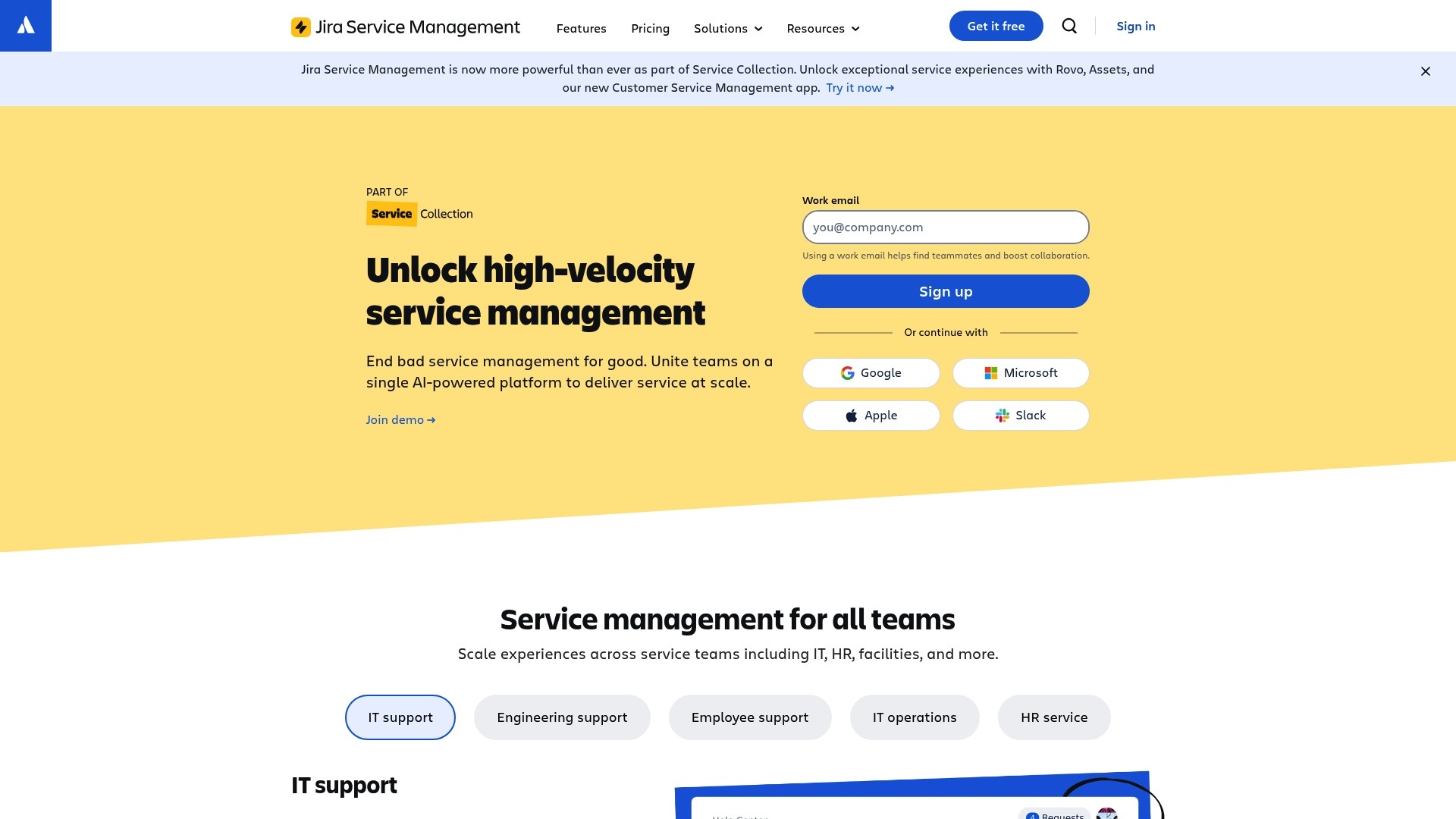
Jira Service Management (JSM) is a service desk, but its Premium and Enterprise plans come with a powerful CMDB and asset management tool called Assets (formerly Insight). Assets lets you create a flexible object schema to track not just hardware and software, but anything you want: employees, locations, and how they all relate.
The main benefit is its flexibility and deep integration within the Atlassian ecosystem. You can build out a full CMDB that perfectly models your IT environment. A key consideration is its pricing model. To get Assets, you need a JSM Premium or Enterprise subscription, which is a big price jump.
On top of that, Atlassian uses a consumption-based model. The Premium plan includes 50,000 "objects" (any item you track), and you will pay overage fees of $0.05 per object per month after that. This can lead to variable monthly costs. For teams that just need simple asset tracking with fixed costs, a marketplace app like Asset Management for Jira offers a more predictable pricing structure.
Pricing
JSM Premium Plan: Starts around $51.42 per agent per month.
Consumption fees: Apply for assets over your plan's limit.
JSM with Assets is the go-to option for teams deep in the Atlassian stack who need a full CMDB. It is more complex than GLPI but offers an integration level that standalone tools cannot match.
5. Freshservice: An all-in-one GLPI alternative
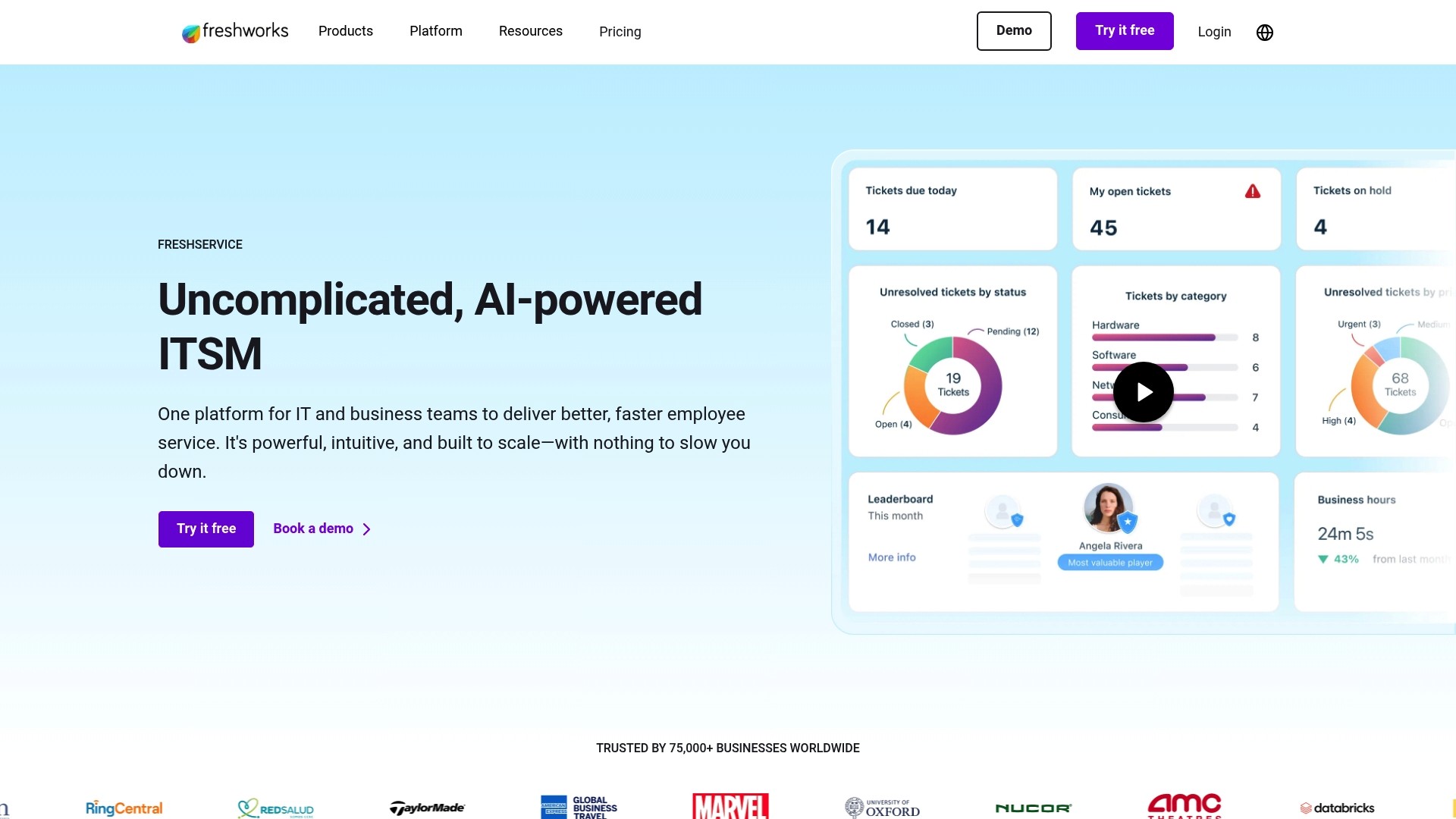
Freshservice is a modern, cloud-based ITSM platform known for its user-friendly interface and all-in-one feature set. It’s a complete ITSM suite where asset management is a key part. It includes automated asset discovery, software license management, and contract management, all connected to its service desk.
It's built to be a single solution for mid-sized IT teams and is used by over 74,000 businesses worldwide (as part of the wider Freshworks suite). A key feature of Freshservice is its user-friendly interface, which facilitates rapid implementation and user adoption. Since it's a cloud platform, there's no infrastructure to worry about, and its clean UI makes it simple for teams to get on board.
While it integrates with other tools, the connection to development workflows in platforms like Jira is not as seamless as a native tool. The per-agent pricing can also become a significant cost factor as a team grows.
Pricing
Starter: From $19/agent/month (billed annually).
Growth, Pro, and Enterprise tiers: Offer more advanced features at higher prices.
Freshservice makes the list as the best all-in-one cloud option. If you want to replace not just GLPI but your whole ITSM toolset with a single, easy-to-use platform, Freshservice is a great choice.
For a direct visual comparison between two of the most popular open-source options, this video breaks down the key differences between Snipe-IT and GLPI.
How to choose the right GLPI alternative for you
Picking the right tool comes down to your team's specific situation. Focus on the features that align with your team's core needs.
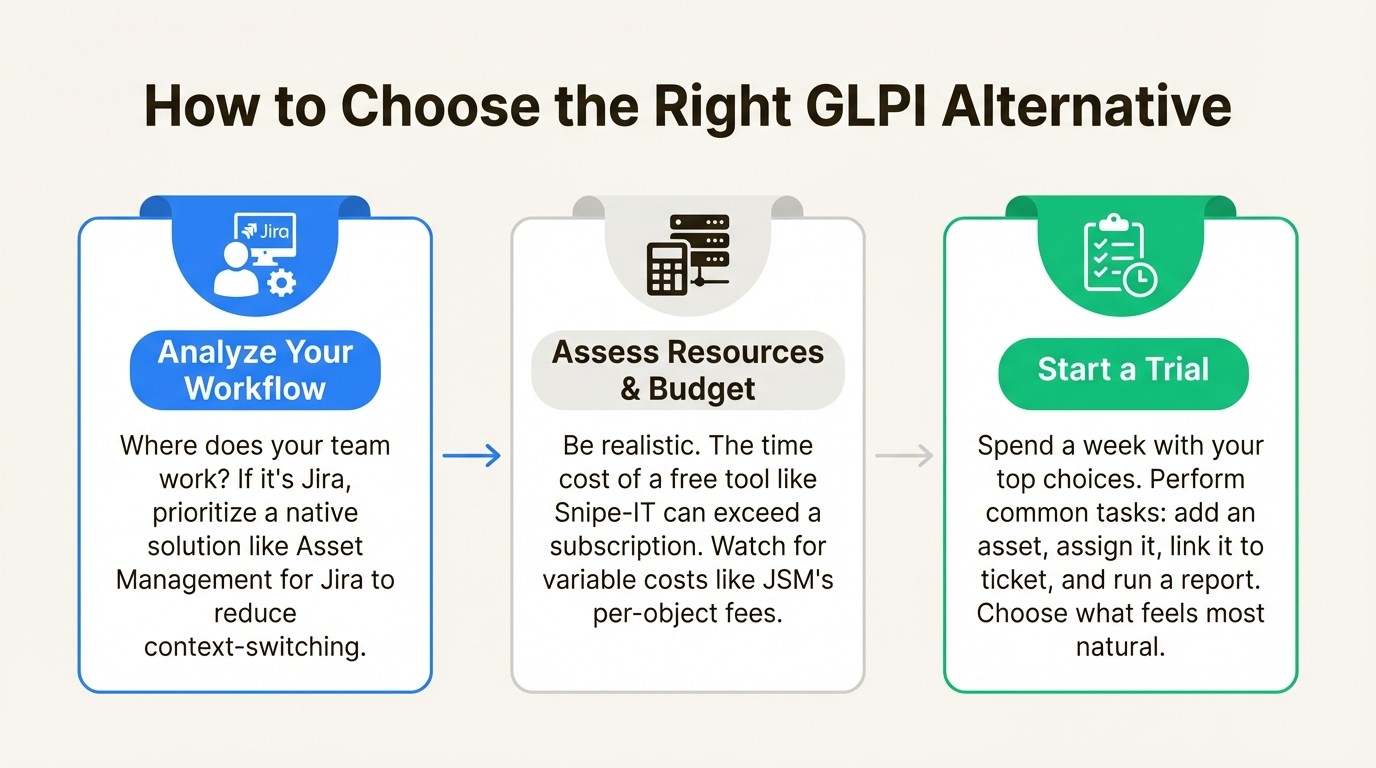
Start by thinking about where your team does its work. If your IT team operates primarily within Jira, a native solution like Asset Management for Jira will almost always provide a smoother workflow than a separate tool. Having asset info directly in your tickets saves time and reduces context-switching for each issue.
Next, be realistic about your technical resources and budget. The appeal of a free, open-source tool like Snipe-IT is strong, but the cost of your team's time can quickly add up to more than a subscription fee. Also, consider variable costs like the per-object fees in JSM Assets, which can complicate budgeting.
Finally, give it a trial run. Spend a week with your top two choices and do your common tasks: add a new asset, assign it to someone, link it to a support ticket, and run a report. The tool that feels the most natural is probably the right one for you.
Finding the right GLPI alternative
Moving on from GLPI is about finding a tool that fits how your team works, not forcing your team to work around a tool's specific design. Whether you need the enterprise capabilities of ServiceNow or the native Jira integration of a marketplace app, there is a solid GLPI alternative out there for you. Just focus on integration and ease of use to make sure your new system actually makes your life easier.
Frequently Asked Questions
Q1: What are the main signs I need a GLPI alternative?
A1: You might need a GLPI alternative if you're spending too much time on setup and maintenance, if your team finds the interface clunky and outdated, or if you need better integrations with modern tools like Jira. If the "free" cost is being offset by high labor costs, it's time to look elsewhere.
Q2: Is a self-hosted GLPI alternative like Snipe-IT really free?
A2: While the software itself is free, a self-hosted GLPI alternative isn't without costs. You have to factor in server hosting, maintenance, security updates, and the time your technical staff spends managing it. These "hidden" costs can sometimes exceed the subscription fee for a paid, cloud-based tool.
Q3: Why would I choose a Jira-integrated GLPI alternative over a standalone tool?
A3: A Jira-integrated GLPI alternative like Asset Management for Jira streamlines your workflow significantly. When asset information lives directly inside your Jira tickets, your support team saves time on every issue. There's no need to switch between systems, which reduces context-switching and leads to faster ticket resolution.
Q4: How does the pricing of a GLPI alternative compare to GLPI itself?
A4: GLPI is open-source and free to use if self-hosted. A GLPI alternative can range from free (like Snipe-IT, self-hosted) to subscription-based SaaS products with per-user or per-asset fees, to expensive enterprise solutions. It's important to calculate the total cost of ownership, including hosting and maintenance, to make a fair comparison.
Q5: When should a large company consider an enterprise GLPI alternative like ServiceNow?
A5: A large enterprise should look at a GLPI alternative like ServiceNow when its needs go beyond basic asset tracking. If you require complex workflow automation, deep compliance and auditing capabilities, and a platform that can manage nearly every aspect of your business operations from IT to HR, then a powerful, scalable solution like ServiceNow is the logical next step.